

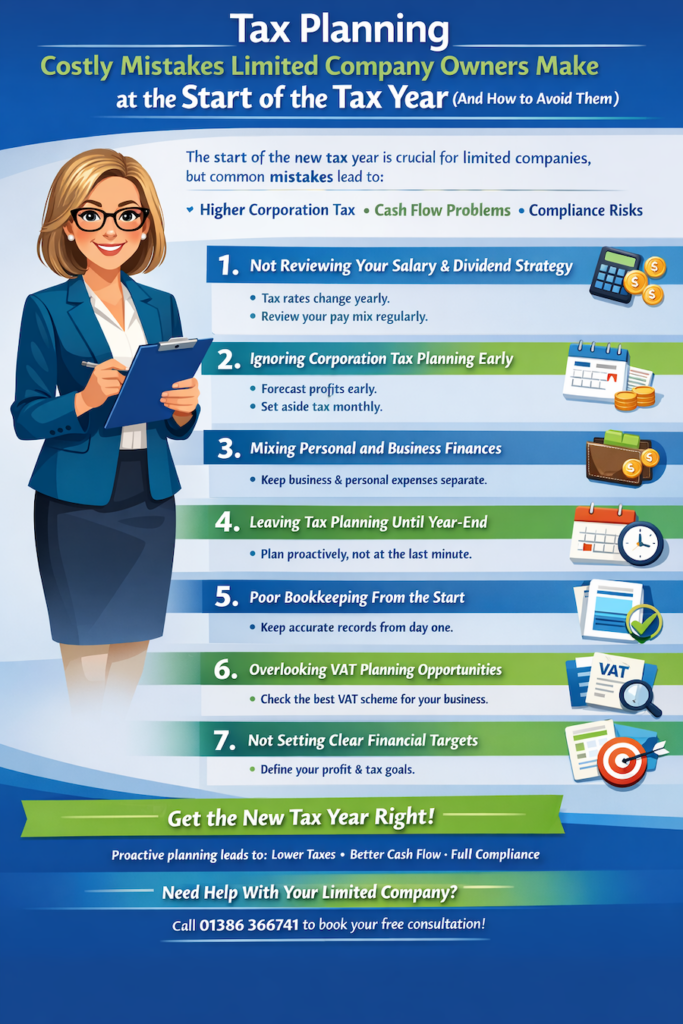
The start of the new tax year is one of the most important moments for tax planning for limited companies in the UK.
Yet many directors fall into the same traps every April – mistakes that quietly lead to:
- Higher corporation tax
- Cash flow problems
- Compliance risks
If you want to run a more efficient and profitable business this year, these are the mistakes to avoid.
1. Not Reviewing Your Salary and Dividend Strategy
One of the most common issues in director tax planning is simply repeating last year’s approach.
Why this is a problem:
- Tax thresholds and allowances change
- Your profit level may be different
- You could be extracting income inefficiently
What to do instead:
Review your salary vs dividend split at the start of the tax year and regularly throughout, not retrospectively. This ensures you’re using allowances correctly and avoiding unnecessary tax.
2. Ignoring Corporation Tax Planning Early
Many business owners delay corporation tax planning in the UK until year-end.
By then:
- Most planning opportunities are gone
- You’re left reacting instead of optimising
What to do instead:
Forecast your annual profit early and estimate your corporation tax liability. Set aside tax monthly to avoid cash flow shocks.
3. Mixing Personal and Business Finances
This is a major red flag from both a tax and bookkeeping perspective.
Common issues include:
- Paying personal expenses through the company
- Taking irregular drawings without structure
Risks:
- Director’s Loan Account complications
- Additional tax charges (e.g. Section 455)
- Inaccurate financial reporting
What to do instead:
Operate a clear and consistent drawings policy and keep personal and business spending separate.
4. Leaving Tax Planning Until Year-End
Effective tax planning for limited companies should happen throughout the year—not just in March.
Waiting too long leads to:
- Rushed decisions
- Missed reliefs
- Poor cash utilisation
What to do instead:
Plan proactively around:
- Pension contributions
- Capital expenditure
- Timing of income and costsEffective tax planning for limited companies should happen throughout the year—not just in March.Waiting too long leads to:
- Rushed decisions
- Missed reliefs
- Poor cash utilisation
What to do instead:
Plan proactively around:
- Pension contributions
- Capital expenditure
- Timing of income and costs
5. Poor Bookkeeping From the Start of the Year
Your financial data is only as good as your bookkeeping.
Starting the year poorly often leads to:
- Misreported profits
- Incorrect tax estimates
- Higher accounting costs
What to do instead:
Maintain accurate, up-to-date records using software like Xero, with monthly reconciliations as a minimum standard.
6. Overlooking VAT Planning Opportunities
VAT is often treated as purely administrative – but it has real strategic impact.
Common mistakes:
- Staying on the wrong VAT scheme
- Missing registration thresholds
- Poor cash flow management
What to do instead:
Review your VAT position annually to ensure you’re using the most efficient scheme for your business.
7. Not Setting Clear Financial Targets
Without defined goals, most businesses drift.
This results in:
- Reactive decision-making
- Inconsistent profits
- Inefficient tax outcomes
What to do instead:
At the start of the tax year, set:
- Revenue targets
- Profit goals
- Expected tax liabilities
This turns your finances into a management tool, not just a reporting requirement.
How to Get the New Tax Year Right
Strong tax planning for limited companies in the UK isn’t about last-minute fixes – it’s about consistent, informed decisions throughout the year.
The most successful directors:
- Review their strategy early
- Stay on top of their numbers
- Make proactive, tax-efficient decisions

Final Thoughts
Avoiding these common mistakes can significantly improve:
- Your tax position
- Your cash flow
- Your overall financial control
The new tax year gives you a clean starting point – what you do in the first few months will shape the rest of the year.

Need Help With Tax Planning for Your Limited Company?
If you want to:
- Reduce your corporation tax
- Improve cash flow
- Stay fully compliant
…it starts with having the right systems and strategy in place early.
To arrange a free call to discuss your business, please call 01386 366741