

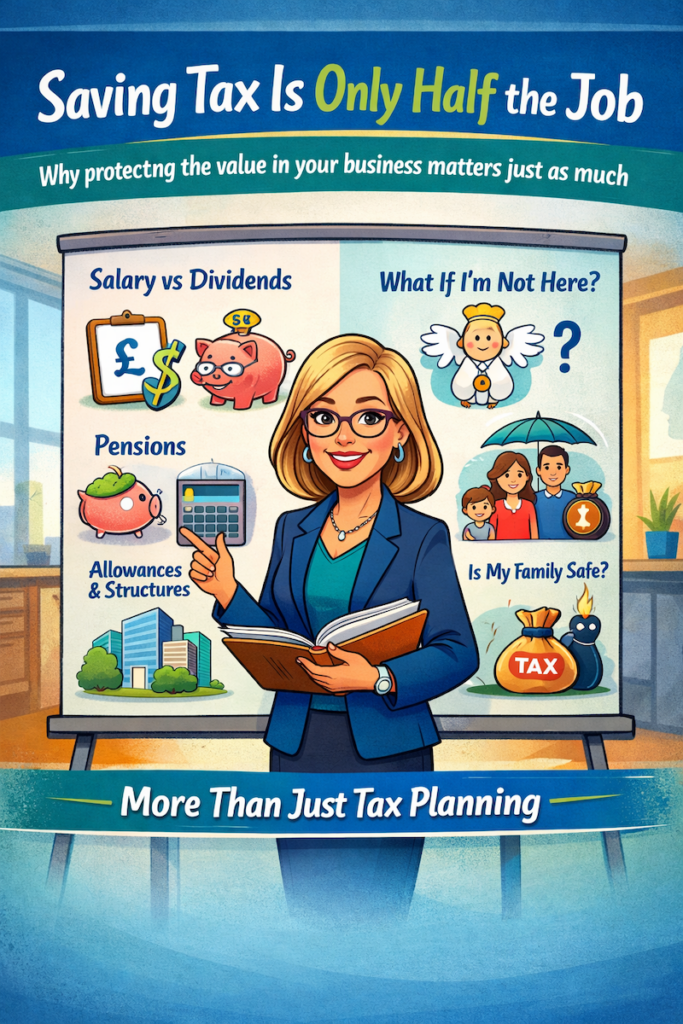
Saving Tax-Why protecting the value in your business matters just as much.
There is no shortage of information online about saving tax.
Salary versus dividends.
Allowances.
Pensions.
Structures.
All of these matter when saving tax. But they are only part of the picture.
What is discussed far less is protecting the value you are building, and what happens to that value if life doesn’t go to plan.
For many business owners, the focus remains firmly on reducing tax today, without stepping back to ask some harder but essential questions:
- What happens to the value in my business if I’m no longer here?
- Is my family genuinely protected, or just hoping things would work out?
- Could tax become a problem at the worst possible moment?
Good financial planning should answer all of those questions, not just the easy ones.
Why this matters more now
Recent changes to Business Relief and the treatment of pensions on death mean that, for some directors, inheritance tax exposure could now be far higher than expected.
In one worked example:
- A trading business valued at £3.5m previously qualified fully for Business Relief
- A pension of £500k was previously exempt
- Under the revised rules, up to £1m becomes taxable, potentially creating an inheritance tax liability of £400,000
For many directors, this comes as a surprise. Businesses that were once assumed to be “safe” from inheritance tax may no longer be, depending on individual circumstances.
This doesn’t mean panic is required.
It does mean planning is.
More than compliance
At The Accountancy Office, our role goes beyond year-end accounts and compliance deadlines.
We work with clients to:
- understand the real value in their business
- identify future risks, not just historic results
- align tax planning with longer-term protection and family outcomes
Tax efficiency is important, but it should never exist in isolation. Decisions made today often have consequences far beyond the next tax return.
A practical example: Relevant Life Cover.
One area where joined-up thinking makes a real difference is life cover for directors.
Many directors assume life cover is a personal cost. In reality, for limited company directors, that is often the most expensive way to arrange it.
Here’s a simplified illustration.
- Annual life cover premium: £748
- If paid personally, the premium must come from salary or dividends
- In the example reviewed, that resulted in a real personal cost of £1,113 per year
The same cover arranged as a Relevant Life policy:
- Is paid for by the company
- Is usually an allowable business expense
- Does not create a benefit in kind
- Pays out to the director’s family, not the company
In that scenario, the net cost to the business was £561 per year.
That’s close to a 50 percent saving, achieved simply by structuring the protection properly.
This is not about selling insurance.
It’s about making sure business and personal planning actually work together.
Joined-up planning, not isolated decisions
Good financial planning isn’t just about paying less tax this year.
It’s about:
- protecting the value you’re building
- reducing uncertainty for your family
- making informed decisions with long-term consequences in mind
For business owners who have spent years building something valuable, those conversations matter just as much as the numbers on the tax return.
If your planning has focused mainly on compliance and short-term tax savings, it may be time to step back and look at the bigger picture.
Get in touch to arrange your free consultation with a member of financial planning team.